
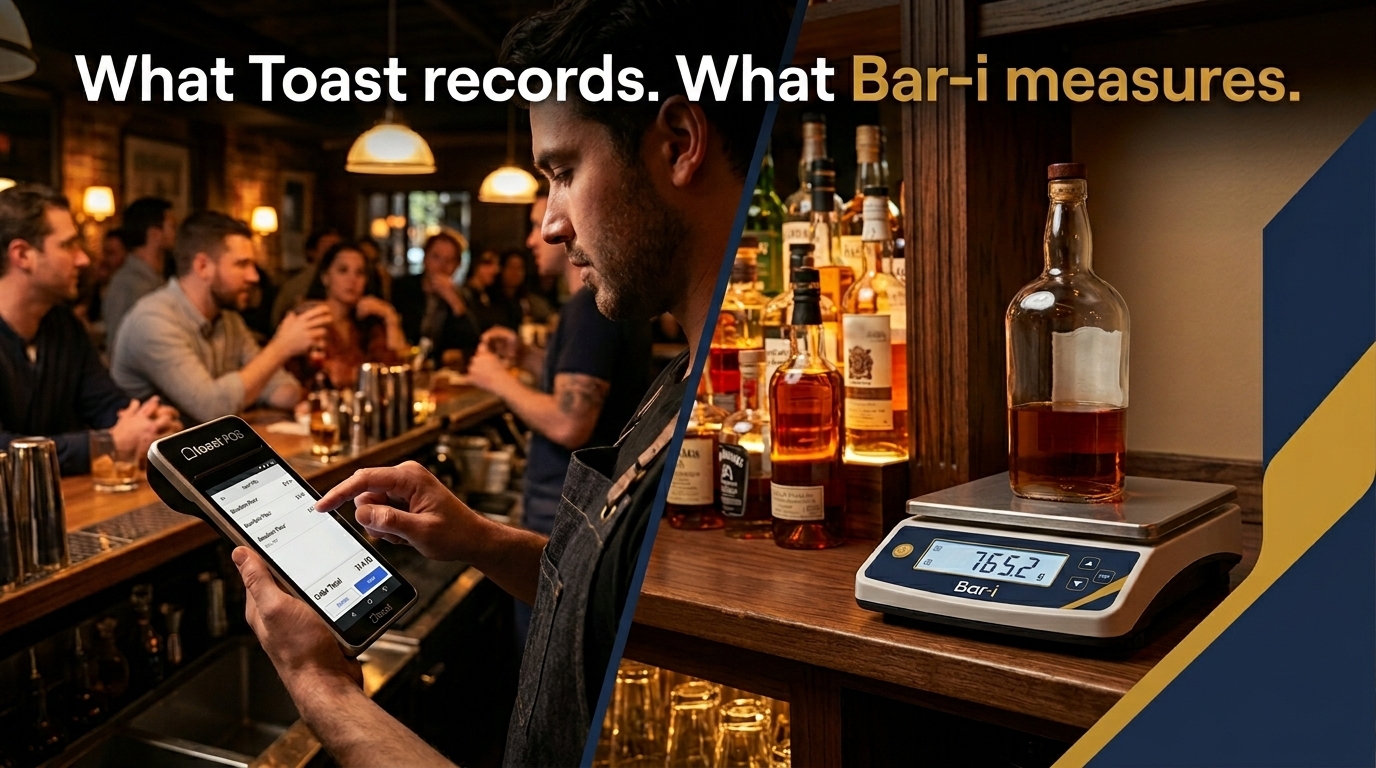
"Toast records every sale. Bar-i measures every pour. Together, they give you the truth about what's actually happening behind your bar."
Toast POS is one of the most powerful restaurant technology platforms available today — purpose-built for foodservice, trusted by over 100,000 restaurant locations across the United States. If you're running your bar on Toast, you already have excellent visibility into what your customers ordered and what they paid for.
But here's the gap every Toast operator eventually confronts: Toast records what was rung up. It cannot measure what was poured. The difference between those two numbers — what was sold versus what was consumed — is where bars lose an average of 15–20% of their gross bar revenue to over-pouring, theft, and untracked pours.
Bar-i was built to close exactly that gap. By connecting Toast's itemized sales data to Bar-i's precision physical inventory system, every sale becomes a recipe deduction, and every pour becomes accountable — down to the tenth of an ounce, per product, per serving.
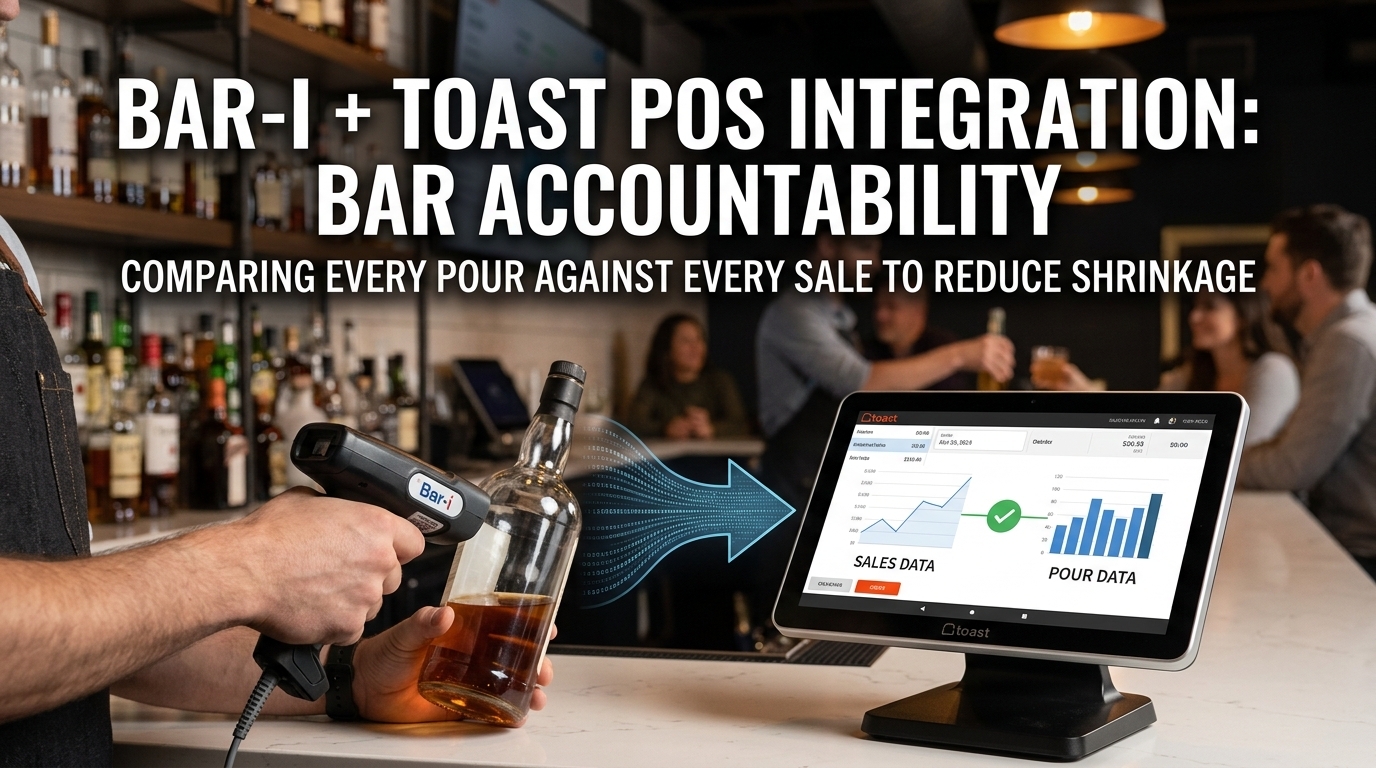
Does Bar-i integrate with Toast POS? Yes. Bar-i integrates with Toast POS by importing the itemized Product Mix report from your Toast account and comparing it against physical bar counts conducted with Bar-i's Speed Count system (up to 500 items/hour, 0.1 oz precision on open bottles). The result is a product-level accountability score and a dollar-quantified variance report delivered weekly by your dedicated Bar-i account manager.
Why This Integration Matters
Toast was designed from the ground up for restaurants and bars — unlike general-purpose POS systems adapted for foodservice. This restaurant-grade design has a direct benefit for Bar-i's accountability analysis: Toast's Product Mix report is exceptionally detailed, offering itemized sales data at the button level, by modifier, and by revenue center.
That granularity is what powers serving-level accountability. When Toast's itemized Product Mix data — including modifier detail — is combined with Bar-i's physical count system, Bar-i can analyze not just how much product was lost in a given period, but exactly which products and recipes are driving variance, down to the individual serving. That precision is only possible because Toast captures modifier data accurately, and Bar-i's account team maps every button and modifier to exact recipes.
The problem Toast cannot solve is the physical measurement gap. Every button in Toast represents a recipe — a specified amount of product that should have been poured. But unless you measure what's actually in your bottles, you have no way to verify that the recipe was followed. Bar-i fills that role with precision scales, barcode scanning, and a systematic count process that processes your full inventory at up to 500 items per hour.
What Is Toast POS?
Toast is a restaurant-specific POS platform founded in 2011 in Boston, Massachusetts. Unlike general-purpose payment platforms that have added restaurant features over time, Toast was built exclusively for foodservice, which gives it structural advantages in how it handles bar and restaurant operations.
Key Toast features relevant to bar accountability:
- Restaurant-grade tab management and split-check processing designed for bar service flows
- Handheld ordering for floor staff and bartenders, capturing sales at the point of service
- Detailed Product Mix report — every button sold, every quantity, by revenue center
- Revenue center reporting — bar, dining room, patio, and other zones tracked separately
- Modifier tracking for double pours, premium substitutions, and cocktail add-ons
Toast's Product Mix report — which itemizes every menu button sold — is the data source that powers Bar-i's accountability engine. The more specific and accurate your Toast button structure, the more precise your accountability scores.
How the Bar-i Integration Works
Step 1 — Conduct Speed Count Inventory
Bar-i's Speed Count system (mobile app + Bluetooth precision scale + barcode scanner) processes your full bar inventory at up to 500 items per hour. Every open bottle is measured to 0.1 oz — no visual estimates, no guessing.
Step 2 — Export Toast Product Mix Report
Pull the itemized Product Mix report from your Toast account for the count period. This shows every button and modifier sold by quantity for the inventory period. Toast makes this available from the Toast back-office reporting dashboard.
Step 3 — Map Recipes and Import
Upload the Toast data to Bar-i. Bar-i's account team maps every Toast button — and every significant modifier — to a recipe with exact pour sizes and ingredient ratios. This mapping is what converts a list of sales into a precise expectation of how much product should have been consumed.
Step 4 — Receive Weekly Accountability Report
Bar-i calculates Expected Consumption (Toast sales × recipe portions) versus Actual Consumption (physical count variance). Your accountability score per product, dollar variance, trend data, and written recommendations arrive weekly from your dedicated account manager.
The Accountability Formula
Expected Consumption = Sales Units × Recipe Pour Size (oz)
Actual Consumption = Opening Inventory + Purchases − Closing Inventory (oz)
Accountability Score = Expected ÷ Actual × 100%
Dollar Variance = (Actual − Expected) × Current Wholesale Cost Per Unit
A 95% accountability score means 5% of the poured product was not rung up in Toast — lost to waste, over-pouring, or theft. Bar-i quantifies that 5% in exact dollars.
Key Features
Speed Count — Up to 500 Items Per Hour
Traditional manual bar inventory averages 80–120 items per hour. Bar-i's Speed Count system processes up to 500, reducing a full count for a 300-SKU bar from 3+ hours to under 45 minutes. That's a count your team will actually complete consistently, on schedule, every period.
Pro Tip — Audit Your Toast Button Structure Before Integration
Generic Toast buttons ('Cocktail,' 'Whiskey Drink,' 'House Pour') create recipe mapping ambiguity. Before Bar-i setup, audit your Toast menu and rename vague catch-all buttons to specific products. The investment takes an afternoon — and it directly determines how precise your accountability scores will be. More specific buttons = more accurate results.
0.1 oz Precision on Open Bottles
Visual estimation of partial bottles — the "looks like about three-quarters full" approach — is the largest source of inaccuracy in traditional bar inventory. Bar-i's Bluetooth precision scales eliminate estimation entirely. Every open bottle is measured to one-tenth of an ounce. At scale, across hundreds of bottles, that precision difference is the difference between accurate accountability scores and noise.
Serving-Level Accuracy via Modifier Data
Toast's modifier system captures every double pour, premium substitution, and add-on at the transaction level. Bar-i's account team maps every modifier to an exact recipe adjustment — ensuring that a double Maker's Mark is calculated as two pours, not one, and that a premium spirit substitution is tracked against the right product. This modifier-level accuracy is what makes Bar-i's accountability scores precise enough to be actionable, down to the individual serving.
Dedicated Account Manager
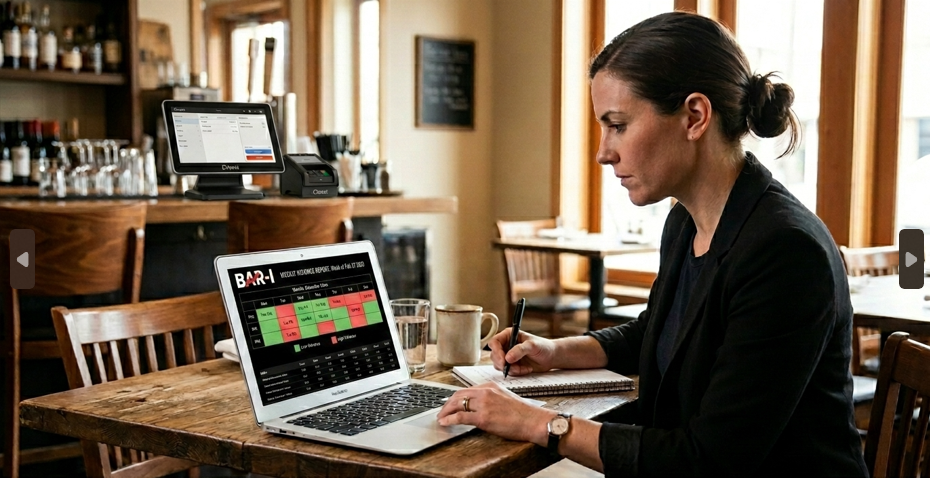
Your Bar-i account manager handles Toast recipe mapping, invoice reconciliation, and weekly written analysis — delivering professional-grade insights without requiring an internal analyst. They know your bar, your button structure, and your variance patterns.
Achievable vs. Actual Pour Cost
Bar-i calculates what your liquor cost should be based on Toast's sales data and your recipes. That 'achievable' cost versus your actual cost shows exactly how much margin is being lost to accountability failures — and how much you can realistically recover.
Multi-Location Toast Support
Manage multiple Toast locations under one Bar-i login with separate accountability reports for each venue.
Real Results: What Bar-i Clients Achieve
|
Metric |
Industry Average (No System) |
Bar-i Clients |
|
Bar Shrinkage Rate |
15–20% of gross bar revenue |
As low as 2% |
|
Liquor Cost Reduction |
— |
3 percentage points average. |
|
Bar Profit Improvement |
Baseline |
Average +30% |
|
Count Speed |
80–120 items/hr |
Up to 500 items/hr |
|
Accountability Score |
80–85% (industry baseline) |
95%+ consistently |
Monthly ROI Example — $50,000/Month Bar on Toast:
$50,000 × 20% beverage cost = $10,000 monthly product cost
$10,000 × 15% shrinkage = $1,500/month in untracked losses
Bar-i reduces shrinkage by approximately. two-thirds → $1,000/month recovered
$1,000 × 2 (conservative recovery multiplier) = $2,000/month bottom-line improvement
Annual improvement: $24,000 | Bar-i bi-weekly service cost: $5,400/year
Net annual gain: $18,600 — approximately 340% ROI
Who Should Use This Integration?
- Bars and restaurants on Toast are generating $25,000+ in monthly bar sales
- Multi-location restaurant groups on Toast who need consistent, comparable accountability data across venues
- Bar managers who want weekly expert analysis and written action recommendations — not just a dashboard to interpret themselves
- Owners whose actual liquor cost consistently exceeds their theoretical (achievable) cost
Pro Tips for Bar-i + Toast POS
Pro Tip #1 — Audit Toast Button Structure Before Integration
This is the single most impactful step before Bar-i setup. Generic buttons ('Cocktail,' 'Premium Whiskey') create recipe mapping ambiguity. Rename vague catch-all buttons to specific products (e.g., 'Maker's Mark Neat,' 'House Margarita 2oz'). More specific buttons produce significantly more precise accountability scores — and make recipe mapping faster.
Pro Tip #2 — Separate Toast Revenue Centers: Bar vs. Dining Room
If your Toast system covers both a bar and a kitchen or dining floor, ensure revenue centers are properly separated before Bar-i setup. Bar-i's analysis is most accurate when it receives only bar-side sales data. Commingled food and bar data creates false variance that dilutes accountability precision.
Pro Tip #3 — Track Comps and Voids Separately in Toast
Comped drinks (served, not charged) are real products poured. Voided items (rung up, not served) should be excluded from expected consumption. Ensure Bar-i's team receives accurate comp and void data for each count period — this prevents phantom variances that aren't real accountability failures.
Pro Tip #4 — Share Accountability Scores with Bar Managers Weekly
Bar-i data is most effective when the bar manager sees it every week — not just ownership. When managers see their team's accountability score and variance by product, behavior changes. Visibility creates accountability without confrontation.
Pro Tip #5 — Use a Spot Count When Variance Spikes on One Product
Once your full counting discipline is established and you're receiving consistent weekly accountability reports, Bar-i can conduct a targeted spot count on a specific product if a sudden variance spike appears. This is a reactive diagnostic tool — not a replacement for full counts. A focused spot count on a flagged item takes minutes and can catch an emerging problem before another full week of loss accumulates.
Frequently Asked Questions
Q: How does Bar-i import data from Toast POS?
Bar-i imports Toast's itemized Product Mix report for each inventory period. Your team exports this from the Toast back-office reporting dashboard and uploads it to Bar-i, where the account team maps each button and modifier to a recipe and runs the accountability comparison.
Q: Does Bar-i work with Toast POS modifiers?
Yes. Bar-i's recipe mapping accounts for Toast modifiers — double pours, premium substitutions, add-ons, and other items that change ingredient volume. Accurate modifier mapping is what separates a precise accountability score from an estimate.
Q: Is the Toast POS integration included in Bar-i's price?
Yes. Toast POS integration is included in all Bar-i subscription plans at no additional charge.
Q: Can Bar-i support multiple Toast POS locations?
Yes. Each location is set up as a separate Bar-i venue with individual accountability analysis. Cross-location comparison reports are available for multi-unit operators running Toast across multiple venues.
Q: What accountability score should I aim for?
Bar-i clients who implement the system's weekly recommendations consistently achieve 95%+ accountability scores. The industry baseline without systematic measurement typically runs 80–85%. The gap between where you start and 95% represents the recoverable margin in your operation.
Q: How quickly does Bar-i produce useful data after connecting to Toast?
Your first count produces your first accountability report immediately. Trend data — which is more powerful for identifying patterns — builds over 3–4 count cycles. Most operators see their first actionable insights within the first week of use.
The Bottom Line
Toast tells you what was sold. Bar-i tells you what that means for your costs — with 0.1 oz precision, serving-level accountability, and weekly expert analysis that reduces shrinkage from the 15–20% industry average to as low as 2%.
For a bar doing $50,000 per month in beverage sales, that accountability gap is worth approximately $24,000 per year in recoverable profit. Bar-i's bi-weekly service for a bar at that volume costs $5,400 per year — a 340% return on investment that compounds every year you maintain the discipline of consistent, accurate inventory.
Book a free Bar-i demo at bar-i.com

-1.png)