
"Reading a Real r/bartenders Thread — and Checking the Numbers Against 50,000 Bar Audits"
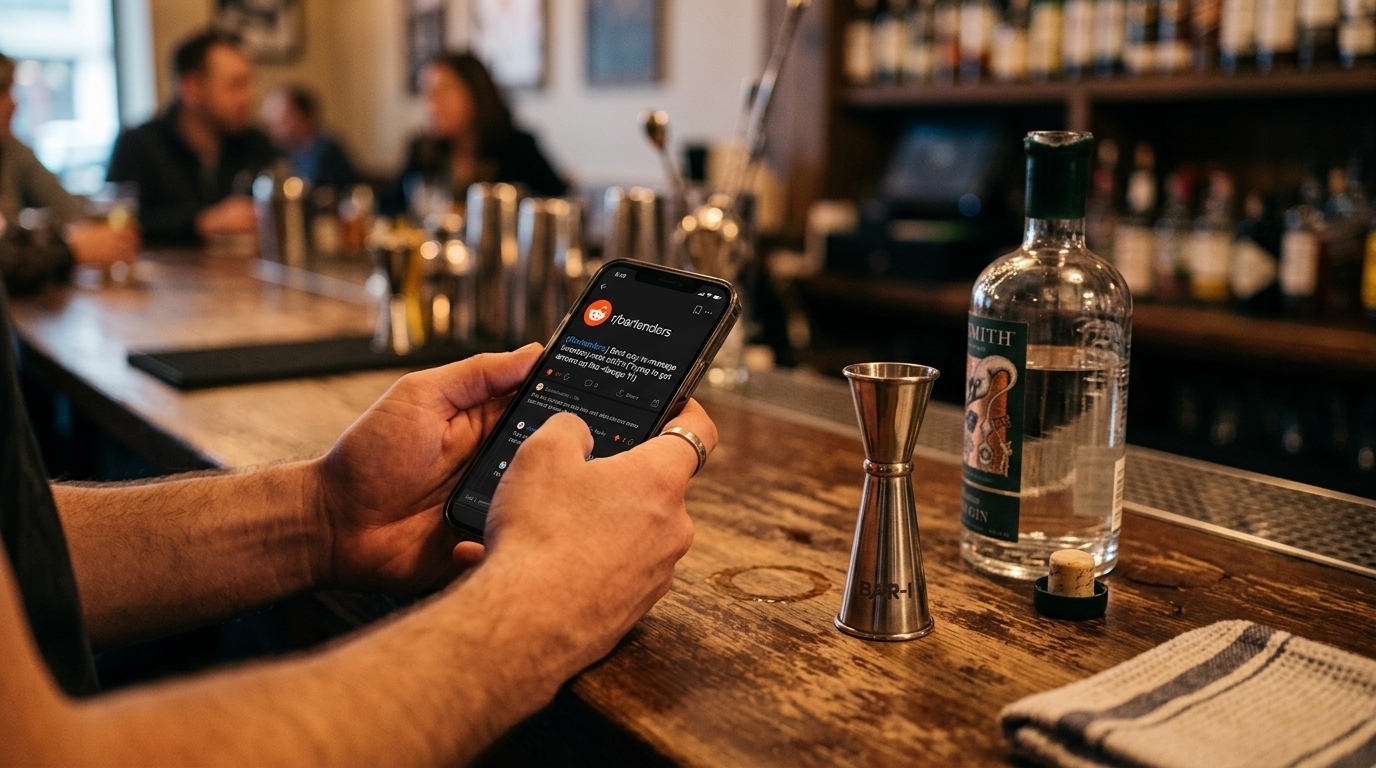
Every so often, a bar manager posts their own pour cost math on Reddit and asks the internet to check their work. It is a small, honest moment — someone who suspects their numbers might be off but is not sure exactly where, and would rather ask a room full of strangers than keep guessing. This is the first in an occasional series where we take one of those real threads from r/bartenders or r/BarOwners, link to the original post, state the question being asked, summarize what other commenters had to say, and then add the perspective we bring from more than 50,000 bar inventory audits over our 17-year history.
The Thread
|
Subreddit |
|
|
Title |
“Does this pour cost math make sense, or are we driving away customers?” |
|
Posted by |
u/galaxynrd, a newer bartender at a startup karaoke venue in the Vancouver, WA / Portland, OR metro area |
|
Comments |
50+ |
|
Link |
https://www.reddit.com/r/bartenders/comments/1pvvxw3/does_this_pour_cost_math_make_sense_or_are_we/ |
The Question
The original poster works at a brand-new karaoke venue with two full bars, run by first-time bar owners who lean on their bar manager for pricing decisions. Worried those decisions might be pushing customers away, the poster laid out three specific examples and asked the community to check the math.
First, a craft cocktail built on a 2 oz pour of Empress Gin, plus fruit, mint, and simple syrup, sells for $14 — but the same 2 oz of Empress Gin poured alone, as a plain shot with nothing else in the glass, is priced at $16. The bar manager's stated rule is to charge roughly a third of the bottle's cost per shot. Second, a 2 oz Hennessy shot is priced at $19, against a bottle cost of $57.31 after local liquor and per-liter taxes — which, by the poster's own math ($19 as a share of $57.31), works out to 33.15% of the bottle's cost, well above the 18–24% range they had read was standard, implying a “correct” price somewhere between $10.32 and $13.75. Third, a Buffalo Trace Old Fashioned — 2 oz Buffalo Trace, simple syrup, bitters, an orange slice, no double — runs $15.60 against a $29.44 bottle cost. The question was direct: is there an actual formula bars are supposed to price against, and is this venue's pricing likely to be sending customers to the bar next door, the gas station across the street, or the other three bars within a block?
Summary of the Discussion
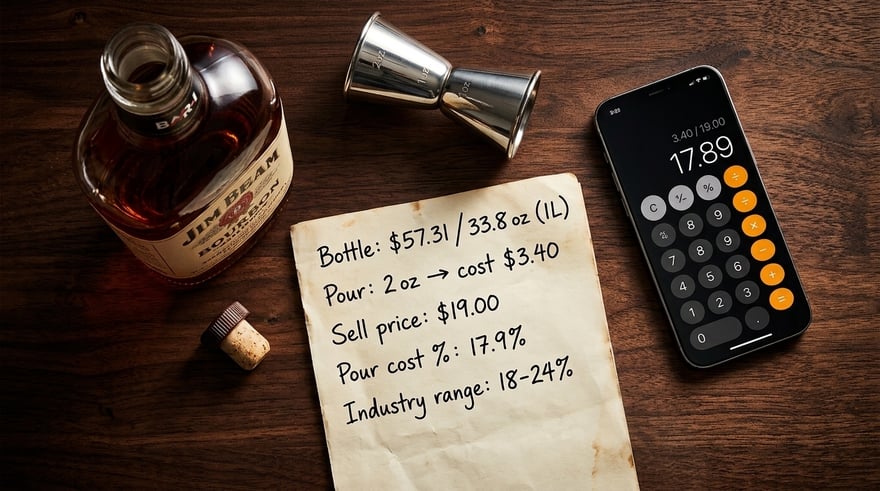
The single biggest thing the thread surfaced was that the original poster's own math was off — and once it was corrected, the picture looked far less alarming than 33% suggested. One commenter walked the arithmetic through directly: at $57.31 per liter, the Hennessy costs about $1.70 an ounce ($57.31 ÷ 33.81 oz per liter), so a 2-oz pour costs about $3.40. Measured the right way — cost of what's poured, divided by the price charged — that $3.40 against a $19 price comes out to roughly 18%, not 33%. A second commenter spelled out exactly why the original calculation was wrong: pour cost is the percentage of the drink's price that pays for the ingredients, not the percentage of the whole bottle's cost that one shot represents. Using the corrected formula, that commenter showed that a 24% pour cost would put the Hennessy shot at $14.16, while an 18% pour cost — what the venue is actually charging — sits at the tight, expensive end of a typical range, closer to $18.88. Several others converged on the same conclusion from their own experience: normal pour cost runs somewhere between 15% and 25%, with most commenters saying they personally run closer to 20–24% rather than the tighter 18% this venue appears to be targeting.
On the Empress Gin pricing, the thread was close to unanimous: charging more for the plain shot than for the built cocktail is backwards. One commenter said they would flip it — price the plain pour at $14 and the cocktail at $16, using a standard $2 upcharge to cover the extra ingredients and preparation, the exact reverse of what the venue is currently doing.
Beyond the specific dollar figures, several of the more detailed comments made the case that pour cost isn't one fixed number applied evenly across a menu. One commenter pushed back directly on the manager's “a third of the bottle” rule, explaining that the real goal is an overall program average — commonly kept under 20% — that has to account for wine and bottled beer typically running closer to 24%, which means liquor has to be priced tighter to balance the blend. That same comment worked through real numbers: a $12-per-liter well bourbon costs about 37 cents an ounce, so a 1.5 oz shot costs 55 cents; sold for $6, that's a 9% pour cost and a $5.45 margin. A $50 bottle priced at $18 a shot costs about $3.30, for roughly an 18% pour cost and a $14.70 margin. A $100 bottle priced at $27 a shot runs about 22% pour cost with a $21 margin. The pattern: the more expensive the bottle, the higher the pour cost percentage, but the bigger the dollar margin — and a healthy program depends on selling far more of the well pours than the top-shelf ones.
A few commenters also raised the volume side of pricing. One laid out a simple comparison: sell a case of beer priced to move 100 units at $10 each, versus the same case priced to move 500 units at $5 each — and by their numbers, the second scenario nets roughly $2,084 in profit against about $917 for the first, even though the percentage margin on each unit is worse. On doubles specifically, one commenter described pricing a double as the cost of the base pour plus 60–75%, rather than doubling the price outright, specifically to make the upsell easy to say yes to.
The Bar-i Spin
The thread's own commenters did most of the hard work already — the corrected Hennessy math and the well vs.Premium bourbon breakdowns are both exactly the right way to think about this. What we'd add is a framework for applying that thinking consistently, at three levels: the drink, the category, and the bar as a whole.
1. Per-Drink Pour Cost
The formula is the one the thread's own commenters used to correct the original post — cost of what's poured, divided by what it's sold for, not price divided by the whole bottle's cost.
Pour Cost = (Cost of Alcohol Poured ÷ Retail Price) × 100%
Applied to the Hennessy example from the thread: a 2-oz pour at roughly $1.70 an ounce costs about $3.40. Against a $19 price, that is a poor cost of about 18% — not the 33% the original post's math implied. It is a useful, fast sanity check, but it only ever describes one drink at a time. For a deeper look at whether your own menu holds up the same way, see Does Your Cocktail Pricing Align with Your Target Liquor Cost?
2. Category Pour Cost
The more useful number, and the one a single-drink formula cannot give you, is the cost by category, tracked over a set period — typically a week. Consider a draft beer program: the starting inventory value at the beginning of the week is $1,500, and by the end of the week, it has fallen to $1,400, a depletion of $100. Add the $700 in draft beer ordered during that same week, and the bar has used $800 worth of inventory in total. Weigh that against $3,200 in draft beer sales rung through the POS over the same week, and the category pour cost comes out to twenty-five percent.
Category Pour Cost = $800 ÷ $3,200 × 100% = 25%
Run the same calculation for each of the four main categories — draft, bottles and cans, liquor, and wine — and a bar gets a real, category-by-category picture instead of a single blended number that can hide as much as it reveals.
|
Pro Tip — Measure Pour Cost by Category, Not Just Overall Break the cost down by category rather than relying on one overall figure. Categories carry meaningfully different costs, and a healthy overall average can quietly mask a single category that is bleeding. |
3. Overall Bar Pour Cost
The same logic scales up to the entire bar: add the total dollars of inventory poured across every category, and divide by total sales for the same period. Pour $4,000 worth of inventory against $20,000 in sales, for instance, and the overall liquor cost works out to twenty percent.
Overall Pour Cost = $4,000 ÷ $20,000 × 100% = 20%
Drawing on Bar-i's experience across more than 50,000 bar inventory audits over our 17-year history, a typical neighborhood bar tends to see meaningfully different costs across categories — something in the range of twenty percent for draft, twenty-five percent for bottles, seventeen percent for liquor, and twenty-four percent for wine, landing at an overall liquor cost of roughly nineteen percent. That lines up closely with what the thread's own commenters described from their own bars — most said they run somewhere between 15% and 25% overall, with a blended average closer to 20–24% being more typical than the tighter 18% this particular venue is charging on Hennessy. A single category running to twenty-four or twenty-six percent is not unheard of, but for the bar as a whole, nineteen to twenty percent is the more typical target.
The Detail the Thread Didn't Flag: Pour Size
Notice that every example in the original post — the Empress Gin, the Hennessy, the Buffalo Trace Old Fashioned — is built on a 2 oz pour. Nobody in the thread questioned that, because 2 oz feels like a normal, even modest, pour size. But it is worth questioning, because it changes the cost picture on every single drink this venue serves before pricing even enters the conversation.
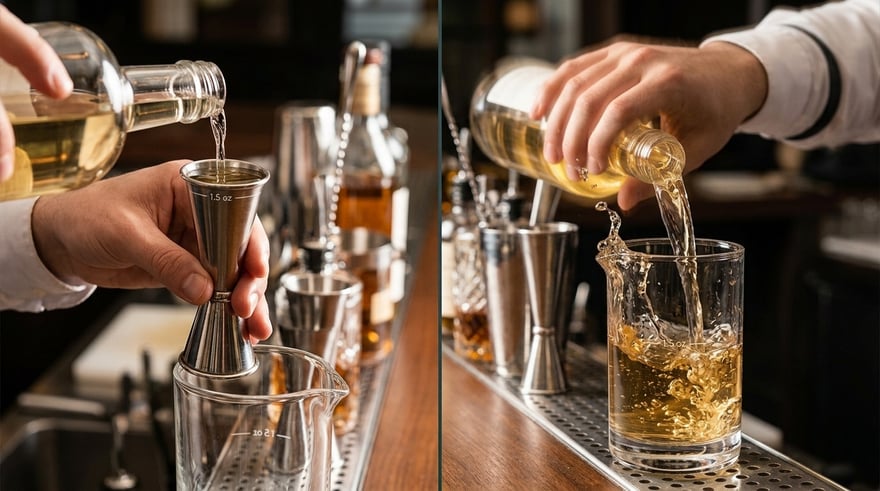
Customers notice price far more readily than they notice portion size. A price of ten dollars on a menu is easy to compare against the bar down the street; a pour that is a half ounce larger than the standard is not something most guests can detect on sight. That asymmetry is where the risk lives — a bar that pours 2 ounces as its standard single instead of 1.5 ounces is giving away a third more alcohol per drink, a gap that shows up as unexplained cost rather than as anything a customer would ever complain about. For the full breakdown, see What Is the Right Pour Size for Liquor Drinks and Cocktails? and 5 Reasons to Use Standard Pour Sizes with Your Liquor Drinks.
|
Pro Tip — 1.5 oz is the Standard for a Reason 1.5 ounces remains by far the most common standard pour, typically paired with a 3-ounce double. 2-ounce pours tend to appear at higher-end venues with a clientele less sensitive to cost, while 1-ounce pours show up more at the low end — casinos and comped-drink environments — where the goal is producing drinks as cheaply as possible. |
Wells vs. Premium: The Thread Already Had This Right
The commenter who broke down the well bourbon and the $50 and $100 bottles was making exactly the point worth building a pricing strategy around: chasing the lowest possible cost percentage on every item is not actually the right goal. Bar-i sees the same pattern across its own audits. Take a well vodka bottle that costs five dollars and yields twenty-two shots — roughly twenty-two to twenty-three cents per shot. Sell that pour for five dollars, and the cost sits at only around four percent of the sale price, but the actual profit on that single drink is about $4.78. Now compare a premium bottle costing forty-five dollars, which works out to about two dollars per ounce. A 1.5-ounce pour of that bottle costs three dollars. Sell it for ten dollars, and the pour cost is thirty percent — far higher than the well pour's four percent — but the actual profit is about seven dollars, more than two dollars higher than the “cheaper” well pour generated. It is the same shape as the thread's own bourbon example, just with different bottles.
The lesson, confirmed from both directions, is that managing purely to the lowest cost percentage can quietly discourage the higher-end pours that make more money in real dollars. Keeping wells and other high-volume products meaningfully below the overall target — fifteen percent or lower is realistic with genuine well products — creates the room to price premium pours at a higher percentage while still landing on target overall, and while generating more profit per drink along the way. It's one of several frequently overlooked strategies for determining liquor pricing at your bar.
Pricing Doubles: What the Thread Already Suggested
One commenter in the thread described pricing a double as the cost of the base pour plus 60–75%, rather than doubling the price outright — the same instinct behind the approach Bar-i generally recommends, just at a slightly different number. Instead of doubling the price of a ten-dollar drink to twenty dollars, price the double at roughly fifty percent more than the single, so it becomes fifteen dollars. The percentage margin on that particular pour goes down, but guests order the upgrade more often as a result, and overall sales rise even as the margin on that specific drink comes down. Whether the exact figure lands at 50% or 75% more, the direction both the thread and Bar-i's own data point to is the same: a steep discount on the double beats a straight multiple. For more on finding the right number across your whole menu, see What Is a Good Price Point for Alcohol Sales?
|
Pro Tip — Keep Pour Sizes to Just Two Keep pour sizes simple — a single and a double are generally enough. Adding separate sizes for shots, neat pours, and rocks pours means separate POS buttons for each, which adds real complexity to recipe tracking without a clear payoff for most bars. |
The Takeaway
The original poster's instinct to double-check their math was the right one — just not for the reason they expected. The Hennessy pour was never really at 33%; it was closer to 18%, on the tight end of normal but not the outlier it first appeared to be. The venue's real issues were the ones the thread converged on almost by accident: an Empress Gin cocktail priced backwards against its own base spirit, a “third of the bottle” pricing rule that does not hold up once wells and premium bottles are actually compared side by side, and an entire menu quietly built on 2 oz pours where 1.5 oz is the more standard, more defensible baseline.
None of that requires more debate in a comments section. It requires the right formula applied consistently, category by category and drink by drink, and pour sizes that are actually measured rather than assumed, which is exactly what a structured inventory process is built to produce. See What Type of ROI Can You Expect from Bar-i's Liquor Inventory System? for what that process is actually worth.
Book a free Bar-i demo at bar-i.com
Ready to Increase Your Bar Profits by 30%?
Discover how successful bars reduce liquor costs, improve inventory control, and
increase profits with proven strategies from Bar-i. Click below to get your free
guide and start optimizing your bar's performance.


-1.png)