
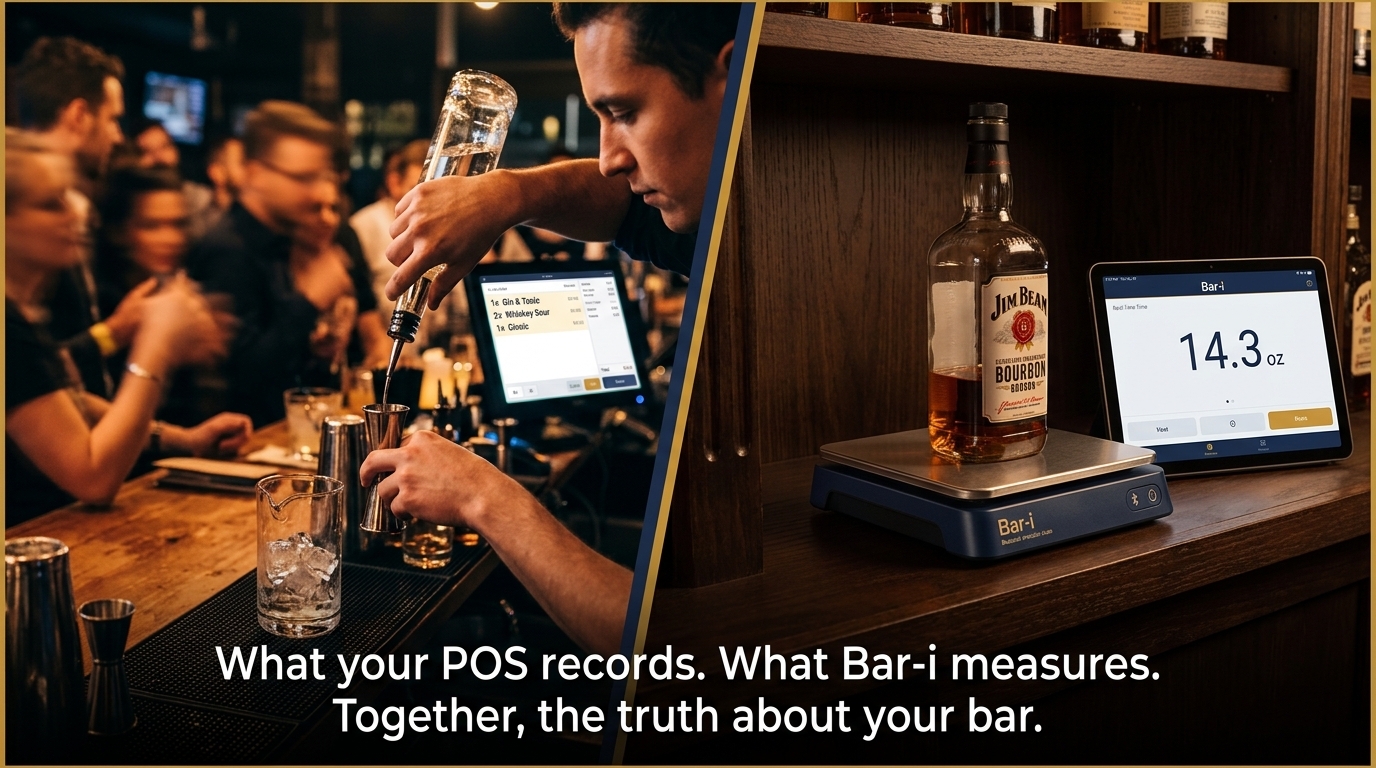
"Most inventory apps promise speed. The best bar inventory software delivers accuracy -- down to the tenth of an ounce, down to the individual serving, with an expert who verifies the numbers and tells you exactly what to do next."
Running a bar without a proper bar inventory system is like running a business without an accounting process. You know money is moving -- you're just not sure where it's going. According to industry data, bars lose 15 to 20 percent of their gross bar revenue to shrinkage: over-pouring, untracked pours, theft, and waste. For a bar doing $50,000 per month in beverage sales, that's $7,500 to $10,000 in lost retail value walking out the door every single month.
The right bar inventory management software closes that gap. But not all platforms are built the same way, and the difference between a basic app and a true accountability system can mean $24,000 or more per year in recovered profit.
This guide compares the leading bar inventory software options in 2026 -- what each one does well, where each one falls short, and what separates surface-level inventory counting from the kind of verified, serving-level accountability that actually moves the needle on your liquor cost.
A Note on Terminology: Scanning vs. Weighing
Throughout this guide, two terms carry specific meanings that are easy to confuse:
- Scanning refers to barcode scanning -- using a physical barcode scanner to identify a product by reading its barcode label. This is how items are looked up in the inventory database.
- Weighing refers to physically placing a bottle on a precision scale to measure how much liquid remains. This is how open bottle quantities are recorded.
Both scanning and weighing are relevant to bar inventory, but they serve different functions. Some systems use one, some use both, and some use neither -- relying instead on visual estimation. The distinction matters significantly for accuracy.
What is the best bar inventory management software?
It depends on what your bar actually needs. Backbar is a strong free option for independent bars focused on ordering and basic cost tracking. WISK works well for multi-location groups that need broad POS compatibility. Partender is fast and easy to learn for teams new to inventory.
For bars that need to know not just what is on the shelf but exactly what was poured versus what was sold -- by product, down to the individual serving -- the standard shifts significantly. At that level of accountability, the platform needs precision physical hardware (not visual estimation), recipe-level POS integration including modifiers, and an expert who manages the implementation, verifies the results, and tells you what to do with them.
Bar-i is one of the few platforms specifically designed to deliver all three.. That combination is what separates inventory counting from inventory accountability -- and accountability is what actually reduces shrinkage and improves liquor cost.
Why Bar Inventory Software Matters -- The $108,000 Problem
Before comparing platforms, it's worth understanding what's at stake. The bar industry's shrinkage benchmark -- 15 to 20 percent of gross bar revenue lost to over-pouring, untracked pours, waste, and theft -- is not a rounding error. It is the single largest controllable cost driver in bar operations, and it is invisible without systematic measurement.
A bar doing $50,000 per month in beverage sales that operates at 18% shrinkage is losing approximately $9,000 per month -- $108,000 per year -- to product that was consumed but never properly tracked or charged. Most operators sense something is wrong. Their actual liquor cost consistently exceeds their theoretical cost. But without product-level data, they cannot identify which products are driving variance, which staff members are over-pouring, or whether the issue is theft, recipe drift, or measurement error.
That is the problem that bar inventory management software exists to solve. The question is: which software actually solves it?
The 3 Levels of Bar Inventory -- Why Most Software Stays at Level 2
Understanding bar inventory software requires understanding that not all inventory systems measure the same thing. Bar-i pioneered the framework of three distinct inventory levels, each delivering progressively more actionable data.
Level 1: Inventory for Ordering
The most basic form -- a visual walk-through to assess what needs to be reordered. No software required. Prevents stockouts. Provides zero performance data.
Level 2: Inventory for Liquor Cost
The industry standard for most bars. Uses the tenthing method -- estimating bottle fullness in tenths -- to calculate a category-level liquor cost (draft beer, bottled beer, liquor, wine). Most inventory apps on this list operate at Level 2 or offer a limited version of it.
The critical limitation of Level 2: When you collapse 100+ individual products into four category costs, you cannot determine whether a cost increase reflects operational decline or a simple shift in product mix. Category data tells you there's a problem. It cannot tell you what the problem is.
Level 3: Product-Level Accountability -- Down to the Serving
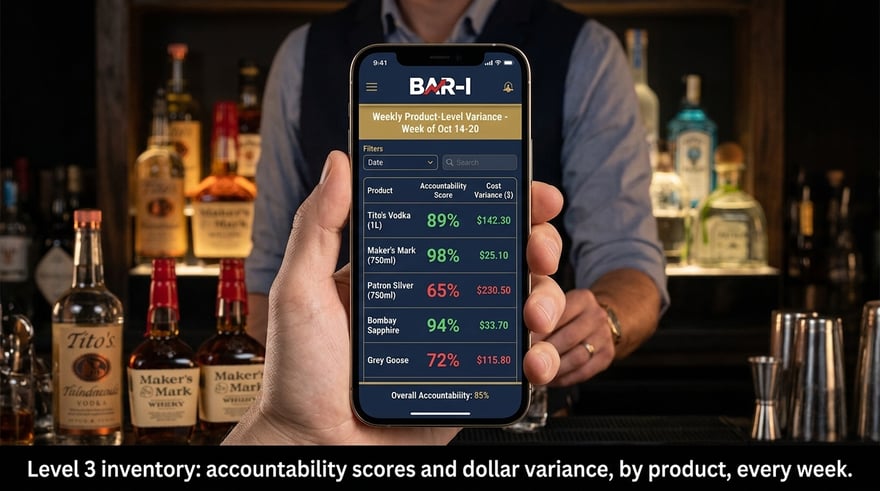
Level 3 measures individual product usage in ounces, reconciles it against POS sales data at the recipe level, and calculates exactly how many servings of every product were poured versus how many were rung up. It produces an accountability score per product and a dollar variance by SKU -- so you can see that your Tito's is running 12% over-pour and your well whiskey is showing $340 in monthly variance. Only a small number of platforms can deliver true Level 3 inventory. Bar-i is the platform designed specifically to achieve it.
The 2026 Bar Inventory Software Landscape: Platform-by-Platform
Bar-i -- Best for Serving-Level Accountability with Expert Support
Bar-i is a full-service bar inventory platform built around the principle that accountability requires both precision technology and trained human oversight. Unlike software-only competitors, Bar-i combines a mobile app, Bluetooth precision scales, physical barcode scanning hardware, and a dedicated account manager into a single weekly service.
What sets Bar-i apart:
- Physical weighing at 0.1 oz precision — Every open bottle is weighed on a Bluetooth precision scale. No visual estimation. No slider guessing. The scale communicates the measurement directly to the app in under 3 seconds per bottle.
- Barcode scanning with a physical barcode scanner — Products are identified by scanning their barcodes using a dedicated physical barcode scanner, not by typing product names or using a camera. The benefit of a physical barcode scanner is that it instantly differentiates between brands, sizes, flavors, vintages, versions, and other subtleties -- even in low-light storage areas. Competitors that rely on manual product selection by name or photo matching typically see persistent issues with version control of items. A physical barcode scanner also works faster and more reliably than camera-based scanning in real bar environments. Watch this demonstration comparing a physical barcode scanner against a camera-based system.
- Level 3 accountability down to the serving — Bar-i's recipe module maps every POS button -- including modifiers (double pours, premium substitutions, add-ons) -- to exact pour sizes. Expected consumption is calculated from your actual sales. Actual consumption is measured from physical counts. The delta, in ounces and dollars, is your accountability score per product and your cost variance in dollars by SKU. Bar-i also consults with clients on how to update their POS programming to increase precision and accuracy, provides live setup support, assists with weekly data entry and processing, and offers ongoing coaching and interpretation of results.
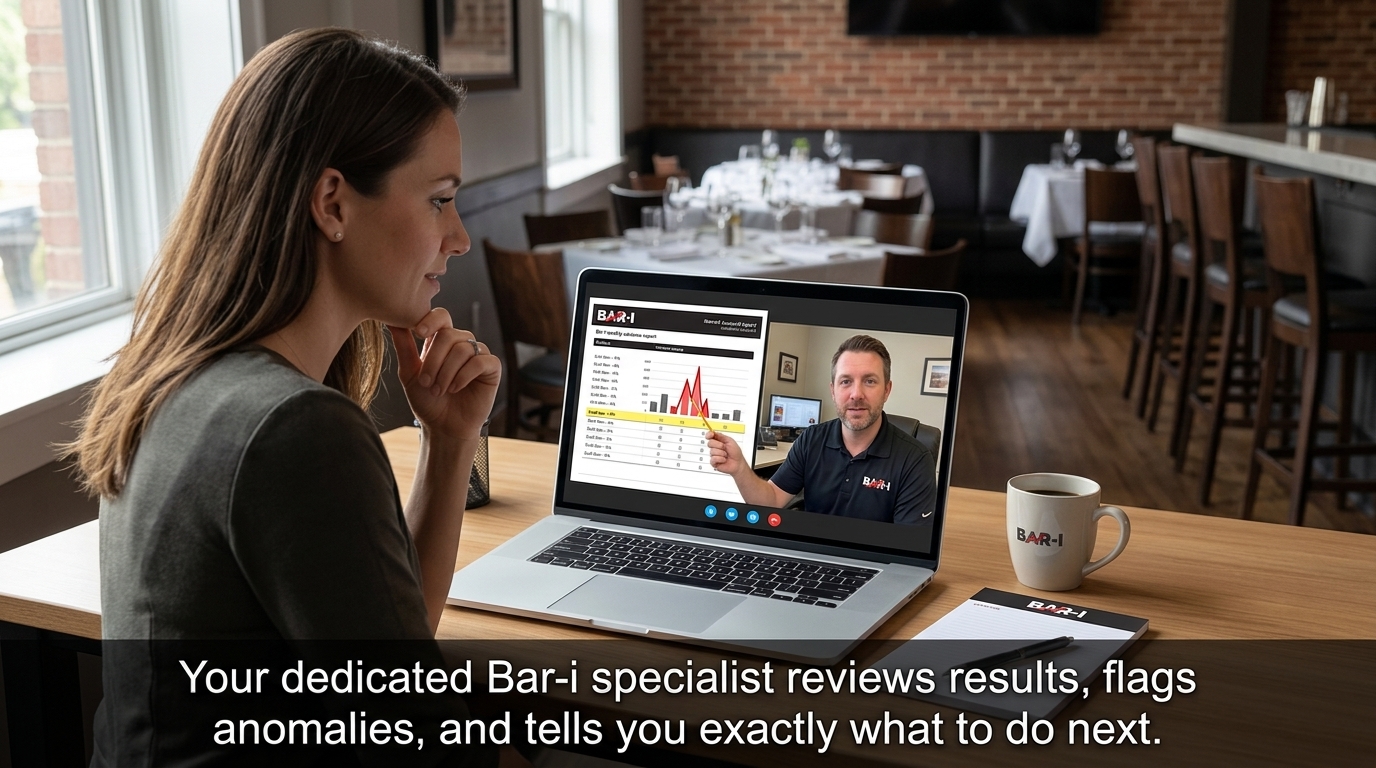
- Dedicated inventory specialist — Your Bar-i account manager handles recipe mapping, invoice reconciliation, and weekly written analysis. They are a trained specialist who knows your bar, walks managers through a dedicated error-resolution workflow (the variance report), and provides written action recommendations -- not just data to interpret yourself.
- Speed Count -- up to 500 items per hour — Traditional manual counting averages 80-120 items per hour. Bar-i's Speed Count system, combining shelf-to-sheet mapping, barcode lookup, and Bluetooth scales, processes full bar inventories at up to 500 items per hour -- reducing a 300-SKU bar from 3+ hours to under 45 minutes.
Results: Bar-i clients reduce shrinkage from the 15-20% industry average to as low as 2%. Average liquor cost improvement: 3 full percentage points. For a $40,000/month bar, that is approximately $1,200 in additional monthly profit.
WISK -- Best for Multi-Unit POS Integration
WISK is an AI-powered inventory platform that integrates with 50+ POS systems and offers strong cross-platform compatibility. It claims 99.7% inventory accuracy and supports offline functionality, making it a reasonable choice for multi-location groups that need standardized reporting across systems. WISK does use a scale (Cubit brand) for weighing, though its approach relies on AI visual estimation rather than physical barcode scanning for product identification.
Limitations: While WISK uses a physical scale (Cubit brand) for weighing, it does not use a dedicated physical barcode scanner for product identification, which can still lead to version-control issues in low-light environments. Additionally, while they do offer an expert-level data verification layer, it comes at an extra cost, and the counting speed can vary.
Craftable (formerly Bevager) -- Best for Advanced Users Seeking Feature Depth
Craftable is a capable, feature-rich platform designed for operators who want granular control over their beverage program. It supports recipe costing, POS integration, and invoice management, making it one of the more comprehensive software options available for advanced users.
Limitations: Craftable is a self-service software platform. It does not include dedicated physical counting hardware, and open bottle measurement relies on the tenthing method or visual estimation. There is no included expert account manager -- recipe mapping, variance analysis, and result interpretation are handled by your own team. For operations with high staff turnover or limited internal expertise, the depth of Craftable's feature set can become a liability rather than an asset. The platform delivers the data; what you do with it is up to you.
MarginEdge -- Best for Operations Already Using MarginEdge for Food Cost
MarginEdge is a restaurant management platform that includes a bar inventory component with Bluetooth scale integration and barcode scanning combined in a dedicated hardware device. It is particularly well-suited for operations that already use MarginEdge for food cost management and want to add beverage accountability within the same platform.
Limitations: MarginEdge's primary focus is food and liquor cost management broadly, not bar-specific accountability at the product and serving level. Its bar inventory features are capable but not purpose-built for the kind of product-level variance analysis and expert-guided accountability that Bar-i delivers. Operations looking specifically for weekly written variance reports, per-SKU accountability scores, and a dedicated bar inventory specialist will find MarginEdge's offering falls short of that standard.
Backbar -- Best for Independent Bars Starting with a Free Plan
Backbar offers a Free Forever plan that includes core inventory management features, making it one of the most accessible entry points in the market. It is designed specifically for beverage programs and handles ordering, par management, and basic variance reporting.
Limitations: Backbar operates at Level 2. It does not offer precision scale integration, physical barcode scanning hardware, or POS recipe mapping at the serving level. Its free tier is a useful operational tool for ordering discipline -- but it cannot deliver product-level accountability scores or identify which specific products are driving variance and by how much.
Partender -- Best for Speed of Counting Without Accuracy Requirements
Partender's core feature is speed: staff use a smartphone to count inventory. To log an open bottle, staff look up the product by name (there is no barcode scanning), the app displays a reference photo of the bottle, and staff slide a bar on-screen to estimate the current liquid level by visual comparison with their thumb. The company markets this as a major improvement over manual clipboards.
Limitations: While Partender does offer POS integrations to compare theoretical usage against actual counts, its core weakness is the counting method itself. Because products are looked up by name rather than scanned, there is a risk of selecting the wrong variant -- the wrong size, vintage, or flavor -- of a similar product. The slider interface forces visual estimation: a bottle that is 45% full must be logged by estimating the liquid level by sight. Estimation errors compound across hundreds of bottles, every count. Because the baseline measurements are estimates, the resulting variance data lacks the precision needed for true product-level accountability. Users also report challenges with complex drink recipes, including multiple ingredients and other complex use cases such as batches. Pricing starts at $199/month and requires a yearly commitment.
BevSpot -- Best for Combined Food and Beverage Programs
BevSpot covers both food and beverage inventory from a single platform, making it useful for operations where the kitchen and bar inventory are managed by the same person.
Limitations: BevSpot functions as a mobile-responsive website rather than a dedicated counting app, which can create friction during inventory. While it offers direct POS integrations, it operates fundamentally at Level 2. It lacks physical barcode scanning hardware and precision scale integration, meaning it relies on visual estimates for open bottles and cannot produce the serving-level accountability data that identifies exactly how many ounces of a specific product were over-poured.
AccuBar -- Best for Hardware-First Counting Without Expert Service
AccuBar uses a rugged handheld scanner for bar inventory counts. It supports barcode scanning and claims 99% accuracy, though like Partender , it requires staff to estimate liquid levels visually -- products are identified by scanner, but how much liquid remains in each bottle is still a manual visual judgment. Pricing starts at $149/month per location plus hardware costs of $500-$2,000.
Limitations: AccuBar is an old-school system primarily used by corporate and enterprise hotel chains. While it uses a rugged handheld scanner for product ID, staff must still visually estimate liquid levels for open bottles. The most significant challenge with AccuBar is the substantial upfront hardware cost ($500–$2,000), making it less accessible for independent operators.
How Bar-i's Physical Scanning Achieves Higher Accuracy (and speed)
The fundamental accuracy gap between Bar-i and most competitors comes down to one measurement decision: how open bottles are counted. Open bottles are the highest-variance item in any bar inventory.
To understand why this matters, consider a standard 1-liter bottle of Jim Beam Bourbon. A typical empty 1-liter liquor bottle has a tare weight (the weight of the glass alone) of around 25 ounces. However, because Jim Beam uses a thinner glass design, its specific tare weight is actually only 17 ounces.
Here is where generic inventory apps fail:
- The Visual / Slider App Failure: If a bottle is roughly 1/3 full, it contains about 11 ounces of liquid. A manager using a smartphone slider or the "tenthing" method will look at the bottle, guess it’s "about a third left," and log a visual estimate.
- The Software-Only Scale Failure: Other apps that support basic scales often apply a generic, hardcoded tare weight (like 25 oz) to all whiskey bottles. If they weigh that Jim Beam, the math breaks completely because the system doesn't account for the unique 17-ounce glass weight.
Across a 300-SKU bar, these compounding estimation and tare-weight errors accumulate into meaningless data. You simply cannot achieve true product-level accountability when your baseline numbers are based on guesswork.
Bar-i eliminates this entire problem through a precise, 5-step hardware and software workflow:
- Step 1 - Shelf-to-Sheet Mapping: Bottles are mapped by zone—the same left-to-right path, every count, preventing missed items.
- Step 2 - Precision Bluetooth Weighing: Each open bottle is placed on a Bluetooth precision scale. The scale communicates the exact weight directly to the app in under 3 seconds. Accuracy: 0.1 oz.
- Step 3 - Super-Admin Database Lookup: A physical barcode scanner identifies the product instantly. Bar-i’s master database automatically applies the exact, verified tare weight for that specific SKU (knowing, for instance, that a Jim Beam 1L glass weighs exactly 17 oz, not 25 oz). This eliminates selection errors and version-control issues from manual entry.
- Step 4 - Automated Recording: The app records the precise liquid weight, SKU, and location automatically—no manual data entry or scrolling required.
- Step 5 - Real-Time Zone Checks: A shelf check total is displayed after each section, catching simple counting errors before moving on to the next area.
The result is measurement data accurate enough to deliver a true accountability score per product and a dollar variance by SKU. This level of precision—the kind that can tell you your Maker's Mark is running 8% over-pour while your well vodka is perfectly tracked—requires physical hardware that measures what is actually in the bottle.
What Expert Support Actually Changes
Every platform on this list offers a dashboard. Several offer support teams. Only Bar-i offers a dedicated inventory specialist who functions as an active partner in your bar's beverage inventory efforts. Bar-i specialists have conducted over 50,000 audits from coast to coast. When a variance spike appears on a specific product, they recognize patterns that first-time operators would miss -- and they know whether the issue is likely recipe drift, portioning error, or a specific shift's data.
|
What a Dashboard Gives You |
What a Bar-i Specialist Gives You |
|
Variance data to interpret yourself |
Written analysis with action recommendations |
|
Flags when something looks wrong |
Identifies why it's wrong and what to do |
|
Recipe templates to build yourself |
Full recipe mapping and POS button audit |
|
Invoice upload tool |
Invoice reconciliation verified to the penny by AI and humans |
|
Weekly report generated automatically |
Weekly report including hand-written comments and expert analysis |
Head-to-Head: Bar-i vs. The Competition
|
Feature |
Bar-i |
WISK |
Craftable |
MarginEdge |
Backbar |
Partender |
BevSpot |
AccuBar |
|
Precision physical scales (0.1 oz) |
Yes |
Yes (Cubit) |
No |
Yes |
No |
No |
No |
Partial |
|
Barcode scanning with a physical barcode scanner |
Yes |
No |
No |
Yes |
No |
No |
No |
Yes |
|
Level 3 / Serving-level accountability |
Yes |
Partial |
Partial |
No |
No |
No |
No |
Partial |
|
POS integration (recipe-level) |
Yes |
Yes |
Yes |
Yes |
Limited |
Yes |
Yes |
Yes |
|
Dedicated expert account manager |
Yes |
No |
No |
No |
No |
No |
No |
No |
|
Weekly written recommendations |
Yes |
No |
No |
No |
No |
No |
No |
No |
|
Count speed |
500/hr |
Varies |
Varies |
Varies |
Varies |
Moderate |
Slow |
Moderate |
|
Modifier-level recipe mapping |
Yes |
Yes |
Yes |
Yes |
No |
No |
No |
Yes |
|
Expert-verified invoice reconciliation |
Yes |
Extra cost |
No |
No |
No |
No |
No |
No |
Real Results: What Bar-i Clients Achieve
|
Metric |
Industry Average (No System) |
Bar-i Clients |
|
Bar Shrinkage Rate |
15-20% of gross bar revenue |
As low as 2% |
|
Liquor Cost Reduction |
-- |
3 percentage points average. |
|
Bar Profit Improvement |
Baseline |
Average +30% |
|
Count Speed |
80-120 items/hr |
Up to 500 items/hr |
|
Accountability Score |
80-85% (industry baseline) |
95%+ consistently |
|
Audits Completed |
-- |
50,000+ from coast to coast |
ROI MATH -- $50,000/Month Bar
- $50,000 x 20% liquor cost = $10,000 monthly product cost
- $10,000 x 15% shrinkage = $1,500/month in untracked losses
- Bar-i reduces shrinkage by approximately two-thirds -> $1,000/month recovered
- Annual improvement: $12,000-$18,000 | Bar-i service cost: $5,400/year
- Net annual gain: $6,600-$12,600 -- 120-230% ROI, every year the discipline holds
Who Should Use Bar-i?
- Bars and restaurants generating $25,000+ in monthly bar sales, where shrinkage recovery pays for the service many times over
- Operators whose actual liquor cost consistently exceeds their theoretical (achievable) cost -- and who cannot identify which products are responsible
- Managers who want weekly expert analysis and written action recommendations, not just a dashboard to interpret themselves
- Multi-location groups that need consistent, comparable accountability data across all venues with a single login
- Bars on Toast, Square, or other major POS platforms that want serving-level recipe reconciliation -- not category-level cost tracking
- Any operation that has tried a basic inventory app and found the data doesn't actually change what happens behind the bar
Pro Tips for Choosing Bar Inventory Software
Pro Tip #1 — Ask Every Vendor How They Measure Open Bottles
This is the single most important accuracy question in bar inventory. If the answer is "the app estimates based on a photo," "your staff slides a bar to indicate fullness," or "staff look up the item by name and estimate the level from a reference picture," the data will not support product-level accountability. Precision physical scales are the only method that produces ounce-accurate open bottle measurements.
Pro Tip #2 — Ask Whether Product Identification Uses a Physical Barcode Scanner
Ask specifically how products are identified during counting. A system that requires staff to look up items by typing a name -- even if it shows a reference photo -- introduces version-control risk between similar products. Physical barcode scanners eliminate that risk entirely by reading the actual product barcode from the bottle.
Pro Tip #3 — Require POS Integration That Goes Down to the Modifier
Category-level POS integration ("total liquor sales: $12,400") is nearly useless for accountability analysis. What you need is button-level and modifier-level data -- so a double pour of Maker's Mark is calculated as two pours of Maker's Mark, not one pour of "whiskey." Before committing to any platform, ask specifically how modifier data is handled.
Pro Tip #4 — Do Not Choose a Platform Your Team Will Not Use Consistently
The most accurate system is the one your team counts on for the schedule. If a platform requires 3 hours to count a 300-SKU bar, counts will slip. Look for count speed alongside accuracy. Bar-i's Speed Count at 500 items per hour is specifically designed to make full, consistent counts realistic for the typical bar team.
Pro Tip #5 — Evaluate What Happens After the Data Is Generated
A report is not a recommendation. Most platforms deliver data. Ask: Who interprets it? Who flags anomalies? Who tells your bar manager what to do next? If the answer is "you do, using the dashboard," factor in the time and expertise required -- and consider whether a platform with built-in expert analysis is a more efficient investment.
Pro Tip #6 — Match the Platform to Your Actual Pain Point
If you suspect theft, you need product-level accountability with human verification. If you're struggling to reorder consistently, basic par-based ordering tools may solve the problem. Match the platform to the specific gap -- and be honest about whether your pain is "I don't know what's missing" (Level 3 problem) or "I run out of things" (Level 1 problem).
Frequently Asked Questions
Q: What is the most accurate bar inventory method?
Physical weighing with precision scales (accurate to 0.1 oz) combined with physical barcode scanning for product identification is the most accurate method available for commercial bar inventory. Visual estimation, the tenthing method, name-based product lookup, and AI photo-based approaches all introduce measurement error at the open bottle level -- the most variable and consequential measurement in bar inventory. Bar-i's physical weighing and barcode scanning system achieves accuracy levels that are not possible with software-only approaches.
Q: What is Level 3 bar inventory?
Level 3 bar inventory, a framework developed by Bar-i, is a product-level accountability analysis that compares actual ounces consumed (measured by physical count) against expected ounces consumed (calculated from POS sales x recipe pour sizes). The result is a per-product accountability score and dollar variance -- showing exactly which items are over-poured, missing, or under-rung. It requires both precision physical measurement and POS recipe integration to execute accurately.
Q: Does bar inventory software prevent theft?
Bar inventory software does not prevent theft directly -- but serving-level accountability data makes theft visible and measurable. When a bar operates at 95% accountability, missing product is quantified by SKU. That visibility changes behavior: staff who know every bottle is weighed, every product is scanned, and every pour is compared against a sale ring up more consistently. Bar-i clients routinely see accountability scores improve significantly within the first month, driven substantially by behavior change rather than operational overhaul.
Q: How often should a bar do inventory?
Most high-accountability bar operations count every one to two weeks. Weekly counts generate the trend data that makes accountability scores meaningful -- a single count shows you where you are; weekly counts show you whether you are improving. Bar-i's Speed Count system makes weekly full-bar counts realistic even for large operations, reducing a 300-SKU count to under 45 minutes.
Q: How much does bar inventory software cost?
Pricing varies by platform. Backbar offers a free tier. Partender starts at $199/month and requires a yearly commitment. AccuBar starts at $149/month per location plus $500-$2,000 in hardware. Bar-i pricing ranges from $80 to $250/month -- contact Bar-i to determine the best fit for your bar and to receive a detailed quote. For bars generating $50,000/month or more in beverage sales, the recoverable margin from shrinkage reduction typically exceeds the service cost by a factor of 3-5x within the first year.
Q: What POS systems does Bar-i integrate with?
Bar-i integrates with major bar and restaurant POS platforms, including Toast, Spot On, Lightspeed, Square, Clover, and 35 other POS systems. Integration pulls itemized sales data at the button and modifier level, which is what enables recipe-level expected consumption calculations. Contact Bar-i at sales@bar-i.com to confirm integration with your specific POS system.
The Bottom Line
The best bar inventory management software is the one that actually tells you what's happening behind your bar -- not just what's on your shelves. Most platforms count what you have. A small number compares what you have against what you started with. Only Bar-i compares both of those numbers against what your POS says you sold, at the recipe level, for every individual product, verified by a trained specialist who delivers written recommendations every week.
That is the difference between knowing your liquor cost is 23% and knowing that your Tito's vodka is running 11% over-pour, your well bourbon is showing $280 in monthly variance, and three specific products are responsible for 70% of your total shrinkage.
For a bar doing $50,000 per month in beverage sales, the difference between 18% shrinkage and 2% shrinkage is $96,000 per year. The question is not whether you can afford bar inventory software. The question is whether you can afford to keep operating without Level 3 accountability.
Book a free Bar-i demo at bar-i.com
-1.png)